
Tear Down and Rebuild vs. Renovate: How Austin Homeowners Decide

You have owned a house in Tarrytown or Old Enfield for years, and the lot is now worth more to you than the floor plan sitting on it. That is usually the moment a tear down and rebuild first gets said out loud, often in a kitchen that no longer fits the way the family lives.
It is a real fork, not a formality. A renovation and a tear down and rebuild solve different problems, cost differently, and ask different things of your patience. Many homeowners commit to one path emotionally before they ever compare the two side by side. This is that comparison.
When Renovation Is the Right Call
Renovation wins when the bones are good and the problem is contained. If the foundation is sound, the framing is straight, and the floor plan mostly works, a renovation keeps what is already right and changes what is not, at a scale that is easier to plan around.

A few signals point toward renovating rather than starting over:
- The structure passes a real inspection with no major surprises in the foundation, framing, or roof.
- The footprint and setbacks already work for how you want to live, so you are not fighting the lot to get the layout you want.
- Your budget has a ceiling that a full rebuild would exceed, but a strong renovation would not.
- The home’s age and character are part of why you bought it. Inside Austin city limits, demolishing a house 45 years or older also brings Historic Preservation Office review, which is worth knowing before you decide.
None of that is a knock on rebuilding. It is simply a different set of facts than the ones that point the other way.
When a Tear Down and Rebuild Makes More Sense
A tear down and rebuild becomes the better answer when the existing house is working against you rather than for you. The first trigger is functional obsolescence: a floor plan built for a different era or a different family, with load-bearing walls and mechanical systems in places that make the change you actually want structurally impractical or deeply invasive.
The second trigger is land value. In Austin’s mature central and west-side neighborhoods, the lot under an older, smaller home has often appreciated faster than the house on it. The appraisal district reports land value and improvement value separately, and when the land carries most of the total, the house is contributing less than it once did. Treat that as one signal, not a verdict: condition, scope, and what you want to build still decide it. The Travis Central Appraisal District’s FAQs define what counts as an improvement.
The third trigger is control. A renovation, even a generous one, is still a negotiation with a structure someone else designed. A tear down and rebuild frees your architect from the existing floor plan and framing, though not from the lot itself: setbacks, trees, drainage, and any deed restrictions still apply. That is the difference between adjusting someone else’s house and building the one you asked for. The question comes up often in mature neighborhoods such as Tarrytown and West Lake Hills, where the lots are prized and many of the original houses are now decades old.
If you are evaluating a lot you do not own yet, the infill mechanics of buying a teardown lot (utility connections at the property line, and how teardown lot economics compare with raw land) are covered in our guide to building on your own lot in Austin. This article picks up from the other side of that decision, once you are already in the house.
Tear Down and Rebuild vs. Renovate, Side by Side
| Renovate | Tear Down and Rebuild | |
|---|---|---|
| Best when | Structure and layout are fundamentally sound | Layout, systems, or land value no longer match the site |
| Design control | Constrained by the existing footprint and framing | Architect-led from the ground up, within the lot’s setbacks, trees, and code |
| Permitting | Remodel permits; inside Austin city limits, removing more than half the exterior walls adds the demolition inspection and notification | Demolition permit plus new construction permits, with a notification window |
| Disruption | Sometimes phased while living in part of the home | Full construction timeline, no partial occupancy |
| Where it tends to fit in Austin | A home with good bones on a lot you are not trying to maximize | An established central or west-side lot where the land now outweighs the structure |
What Austin’s Demolition Process Involves
Once a tear down and rebuild is the chosen path, demolition is a permitted, inspected process, not a single afternoon with an excavator. Inside Austin city limits, the City requires a pre-demolition inspection for every total demolition, and for any partial demolition that removes more than half of a home’s exterior walls. Adjacent residential properties must also be notified before demolition begins.
That notification is formal. Five to ten business days before demolition, the general contractor places a yard sign and door hangers and uploads a notification acknowledgment to the City, which starts a notification window of at least five days. Nothing comes down until that window closes. If the home is 45 years or older, the City’s Historic Preservation Office reviews it, and in some cases the Historic Landmark Commission, before demolition can proceed.
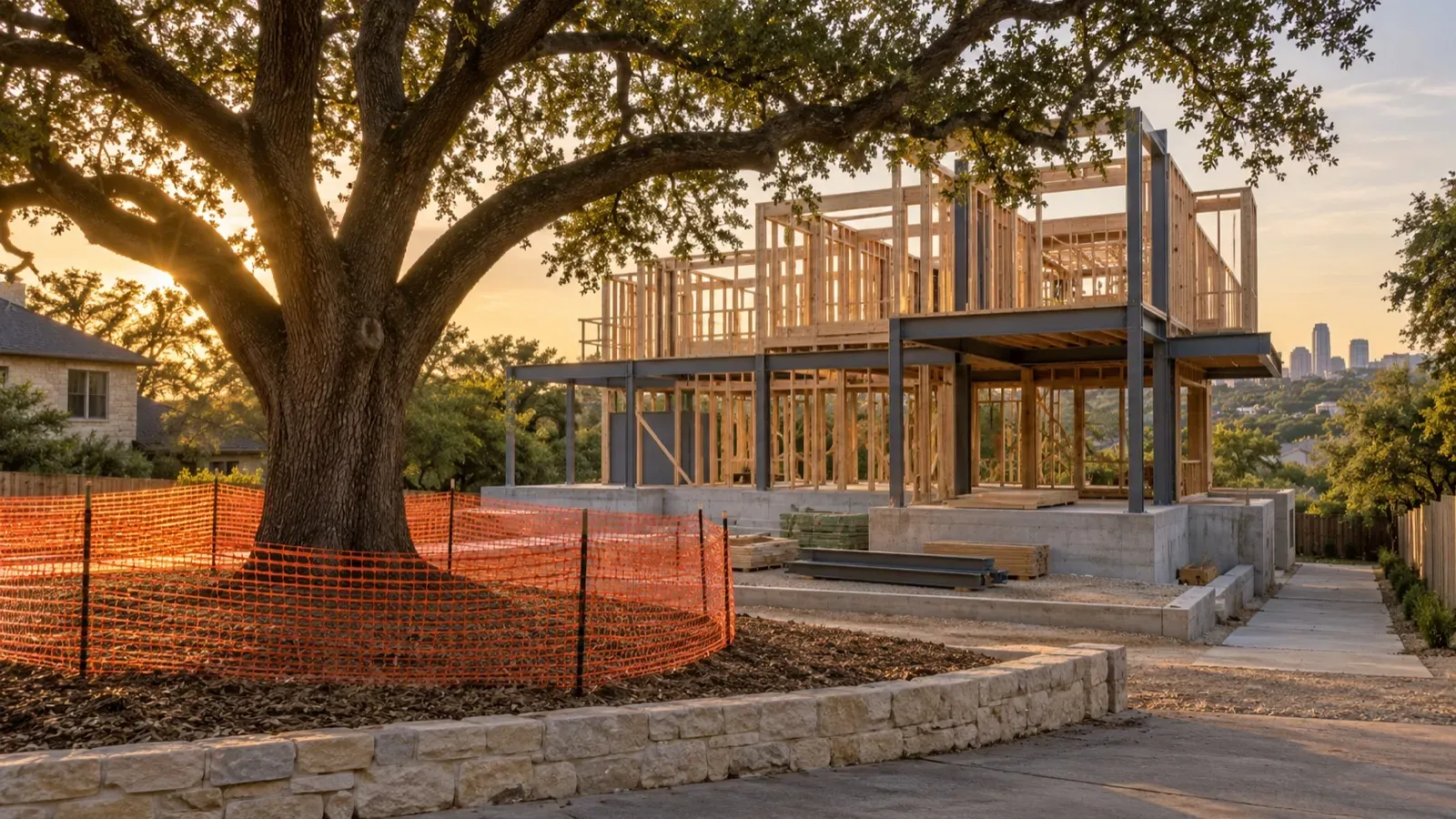
Trees factor in too. If the work would remove a protected-size tree (19 inches or more in diameter), impact its critical root zone, or prune more than 25 percent of its canopy, it needs tree permit review. On a lot with mature oaks, that review can shape where the new house sits, so the trees belong in the first site conversation, not the last. The full process is on the City of Austin’s demolition permit page. These are City of Austin rules. West Lake Hills, Rollingwood, and other separate cities, along with unincorporated Travis County, set their own requirements, so confirm which jurisdiction governs your address before you plan around this sequence.
Budget and Timeline, Side by Side
A cost per square foot means little until it is tied to your lot, your existing structure, and your architect’s plan, so we will not offer one here. What holds directionally is that a tear down and rebuild carries the cost and duration of new construction end to end, from demolition through final finishes, while a renovation’s cost and schedule scale with how much of the existing structure you keep versus replace.
For the real numbers behind either path, our guides to custom home budgeting in Austin and what sets a custom home’s construction timeline walk through both in detail, and our comparison of cost-plus versus fixed-price contracts covers the two contract structures a build can take. A renovation of real scope, one that touches structure and systems rather than finishes alone, can narrow the gap with a tear down and rebuild, which is why both paths deserve a priced scope rather than an assumption.
If our remodeling team walks your existing structure and confirms it can carry the renovation you have in mind, that is often the faster and less disruptive path. If it cannot, a tear down and rebuild stops being the aggressive option and becomes the practical one.
How Do You Know Which Path Is Right for Your Home?
A few questions settle most of this before you call anyone.
What does your land value tell you, separate from the house on it? If the land carries most of your property’s appraised value, the existing structure may not be worth preserving for its own sake, though its condition and character can still argue for keeping it.
Does your neighborhood’s character, or a deed restriction, shape what you can build? Established neighborhoods often carry architectural review or deed-restricted expectations that your design and build team should confirm before you commit either way.
Can your architect get meaningfully more out of a rebuild than a renovation would allow? If the answer is a genuinely different, better house, that is a real reason for a tear down and rebuild. If the answer is a modestly improved version of what you already have, renovation may get you there with less disruption.

Whether you renovate or choose a tear down and rebuild, the right answer comes from your lot, your existing structure, and the home you want to live in.
How do I know if my Austin home is a renovation candidate or a teardown?
Start with the structure, not the wish list. If the foundation, framing, and roof are sound and the existing footprint can hold the layout you want, renovation is usually the faster, less disruptive path. If the floor plan or systems are working against you, or the land value has outpaced the structure, a tear down and rebuild deserves a real look.
Does a demolition permit take longer than a renovation permit in Austin?
It can, because the demolition half of a tear down and rebuild adds steps. Inside Austin city limits, every total demolition requires a pre-demolition inspection and a neighbor notification window of at least five days, and homes 45 years or older also go through Historic Preservation Office review. A renovation that removes half or fewer of the exterior walls does not trigger that inspection and notification.
Is a tear down and rebuild always more expensive than renovating?
Not automatically. A full tear down and rebuild carries the cost of new construction from start to finish, but a renovation that reaches into structure and systems rather than surface finishes can close part of that gap. The comparison only holds once both paths are priced against a defined scope.
What happens if my home is 45 years or older and I want to demolish it?
Inside Austin city limits, demolishing a residential structure 45 years or older requires review by the City’s Historic Preservation Office, and in some cases the Historic Landmark Commission, before the demolition can proceed. Build that review into your schedule from the start.
Can I keep part of the existing structure and still call it a rebuild?
Yes, though the line matters for permitting. Inside Austin city limits, a partial demolition that removes more than half of a home’s exterior walls requires the same pre-demolition inspection and neighbor notification as a total demolition. Your design team can tell you early which side of that line your plan falls on.
Does a tear down and rebuild change my property taxes?
In most cases, yes, upward. In Travis County, a home still under construction on January 1 is added to the tax roll at its percentage of completion, so the change can begin before you move in. The new house also counts as a new improvement, which the 10 percent annual cap on homestead appraisal increases does not shield. Ask your county’s appraisal district to walk through your address before you commit, so the tax change is in the budget from the start.
If you are weighing a renovation against a tear down and rebuild in an established Austin neighborhood and want a clear read on both paths before you commit, start a conversation with our team, and we will walk your lot and your existing structure with you and tell you which path we would recommend, and why.
Planning a custom home?
Our architects and builders work as one team, from the first conversation to the day you move in.