
Residential Greenhouse Design for Hill Country Estates

A beautiful glass box that nobody opens the door to between June and September. That is the most common outcome when a residential greenhouse gets specified for a Hill Country estate out of a catalog, and it happens because almost every greenhouse ever written about was designed for somewhere cold.
Keep the heat in. Extend a short season. Get a jump on spring. None of that is our problem here. In Central Texas the limiting season is summer, when a sealed structure under full sun becomes unusable and the plants inside it are the ones you were trying to protect. Summer survivability has to be designed in here even when the greenhouse’s principal purpose is winter protection, propagation or season extension, and that single reversal changes the glazing, the ventilation, the orientation and where the whole thing sits.
We design kitchen gardens, greenhouses and small orchards into Hill Country estates. This is what we have learned doing it here rather than somewhere else.
Why a residential greenhouse here is a cooling problem
Central Texas summers run brutally hot for weeks at a stretch, and the design number that matters is not an average from an article. It is the actual summer design condition for your site, which is what a greenhouse’s ventilation and cooling should be sized against.
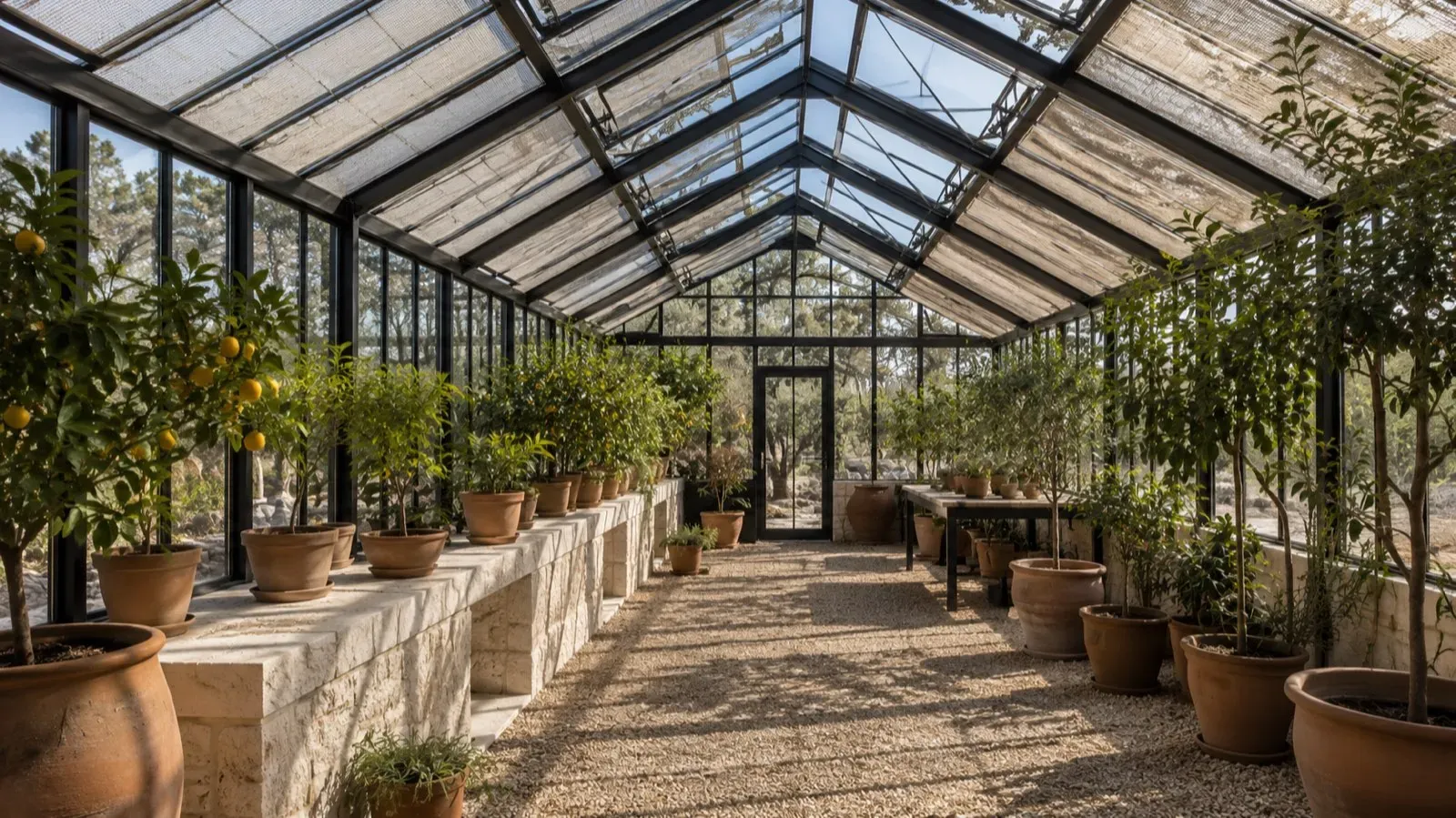
Three things do the work, and none of them show up in a catalog photograph.
Ventilation, sized rather than assumed. For mechanically ventilated houses, extension guidance uses roughly one full air change per minute as a summer fan-capacity benchmark, and that is also what makes fan and pad evaporative cooling work. Natural ventilation is a different calculation: it is sized through operable vent area, geometry, wind and stack effect rather than specified as an air change rate. Either way it rules out a house with a window at each end.
Shade mounted outside, not inside. Retractable shade cloth on the exterior is markedly more effective than the same cloth hung within, for the simple reason that interior shade only intercepts heat after it has already passed through the glazing. This is the single decision that most often separates a workable summer structure from an oven.
Evaporative cooling, where the air allows it. It can be genuinely effective here during sufficiently dry conditions, which is a real regional advantage. It is not a guarantee across an entire Austin summer, because performance is governed by wet bulb rather than by air temperature, and our mornings can be humid. Design it against hourly summer data rather than a rule of thumb.
Heating is the smaller load but it is not zero, and what you need depends entirely on what you are keeping alive. A house intended only to hold off frost is a different specification from one holding a minimum temperature for tender stock through a hard freeze, and the second one wants backup power as well as backup heat. Decide which you are building before anyone quotes glazing.
| Stage | What it covers | What it produces |
|---|---|---|
| 1. Owner inputs | Crop minimum and maximum temperature and humidity limits, operating season, and how long an outage you can tolerate | The heating setpoint, the maximum allowable crop-zone temperature, and whether active heating or cooling is required at all |
| 2. Site and envelope inputs | Orientation, geometry, glazing area and performance, infiltration, exterior shade configuration, and both the winter heating design temperature and the summer cooling design dry-bulb and wet-bulb conditions | The basis for any load calculation |
| 3. Calculated loads | Winter heat loss, summer solar gain and ventilation load, worked from stages 1 and 2 and revisited as the design changes | Numbers rather than adjectives |
| 4. Equipment | Heater capacity, operable vent area, fan capacity, evaporative cooling capacity, controls and backup power | The specification, which follows the loads rather than leading them |
The soil is the first thing to solve, and it is not soil
The Edwards Plateau is thin soil over limestone. On many estate lots there are a few inches before you reach rock or caliche, and what is there tends to be alkaline and low in organic matter.
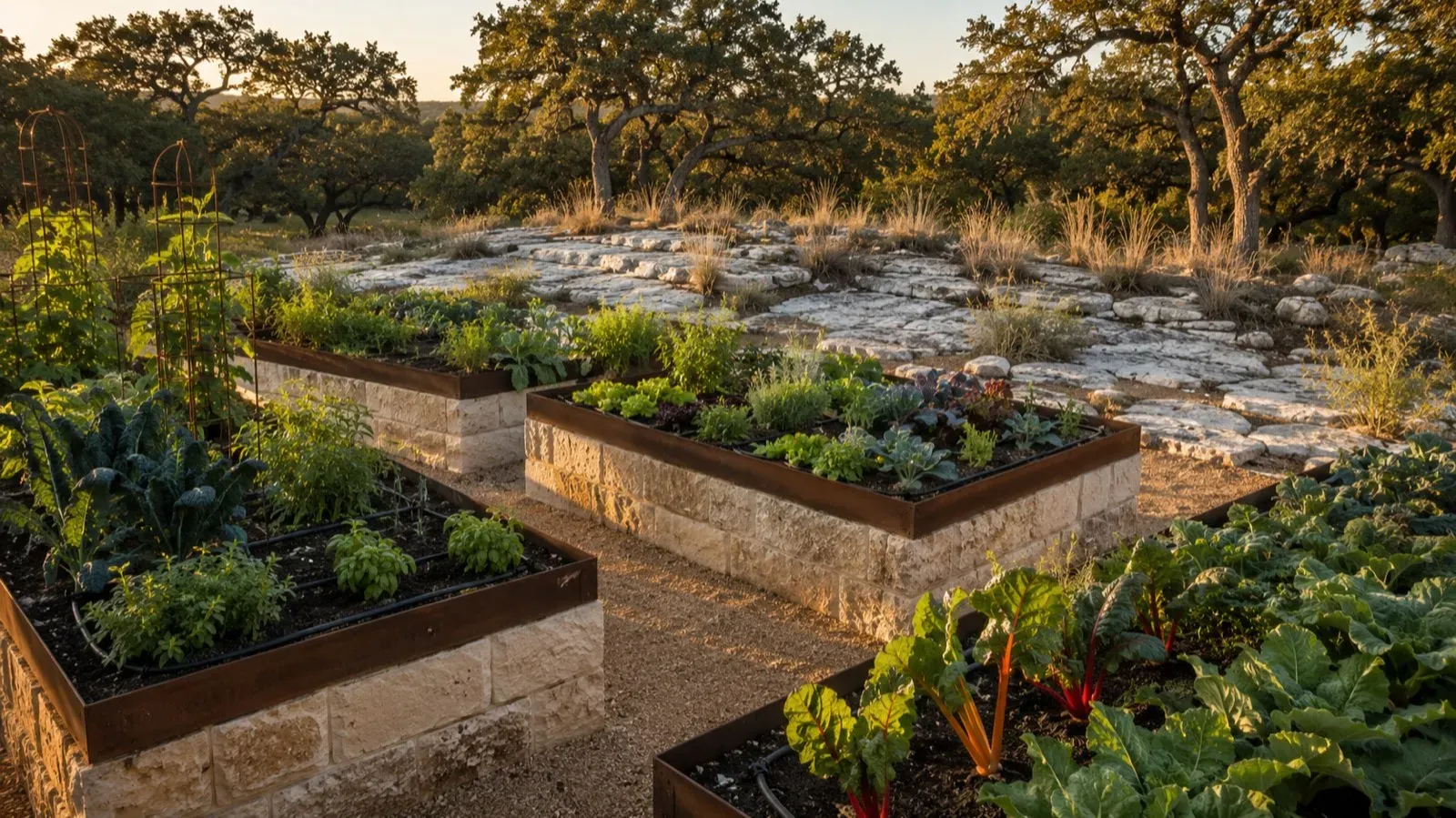
Standard extension guidance for vegetable beds assumes you can till eight to ten inches deep and amend with compost. On a great many Hill Country lots you cannot till to that depth at all, because there is nothing to till. That is one of the strongest site-specific reasons kitchen gardens here get built in raised beds with imported soil, alongside drainage, root-zone control, accessibility and pest pressure. You are not improving the native profile. You are building a growing medium on top of rock.
The design consequence arrives early. Beds full of imported soil are heavy, they need water run to them, and they want a level, accessible, well-drained position close enough to the kitchen that someone actually walks out to them. Settle that at design stage and the water line goes in the right trench the first time.
The water rule that surprises everyone
Here is the fact most people planning a garden here do not know, and it is genuinely good news.
For Austin Water customers, Conservation Stage restrictions have been in force since September 2025. Under them, residential automatic and manual irrigation systems are limited to one day a week within set hours, and hose-end sprinklers and drip irrigation to two days a week. That is what governs the ornamental landscape.
But the city’s exemption list allows several things at any time on any day, and one of them is watering vegetable gardens with a soaker hose or drip irrigation. Watering with a hand-held hose or a refillable container is also exempt, as is watering trees with a bubbler or soaker hose.
So a kitchen garden on drip is not fighting the restriction schedule that governs the rest of your landscape. It sits in the exemption. Design the beds on drip or soaker from the beginning and you have a productive garden that stays watered in the weeks when the lawn cannot be. Stages do change with the level of the Highland Lakes, so confirm the current one rather than trusting any article.
On supply, Texas law is unusually friendly to rainwater harvesting. Section 202.007 of the Texas Property Code prevents a homeowners association from prohibiting rain barrels or a rainwater harvesting system, subject to conditions in the statute covering things like placement relative to the street, common property, and reasonable requirements on appearance. The City of Austin has also offered rebates toward residential rainwater harvesting. Programs change, so treat current terms as something to confirm.
Where we are already sizing catchment for the house, extending it to the garden avoids duplicating infrastructure, though how far it goes depends on catchment area, demand, storage and distribution. We went into that detail in our piece on rainwater collection systems for Hill Country custom homes.
Deer decide the fence before you decide the layout
This constraint quietly determines the shape of the whole garden, and clients underestimate it more than any other.
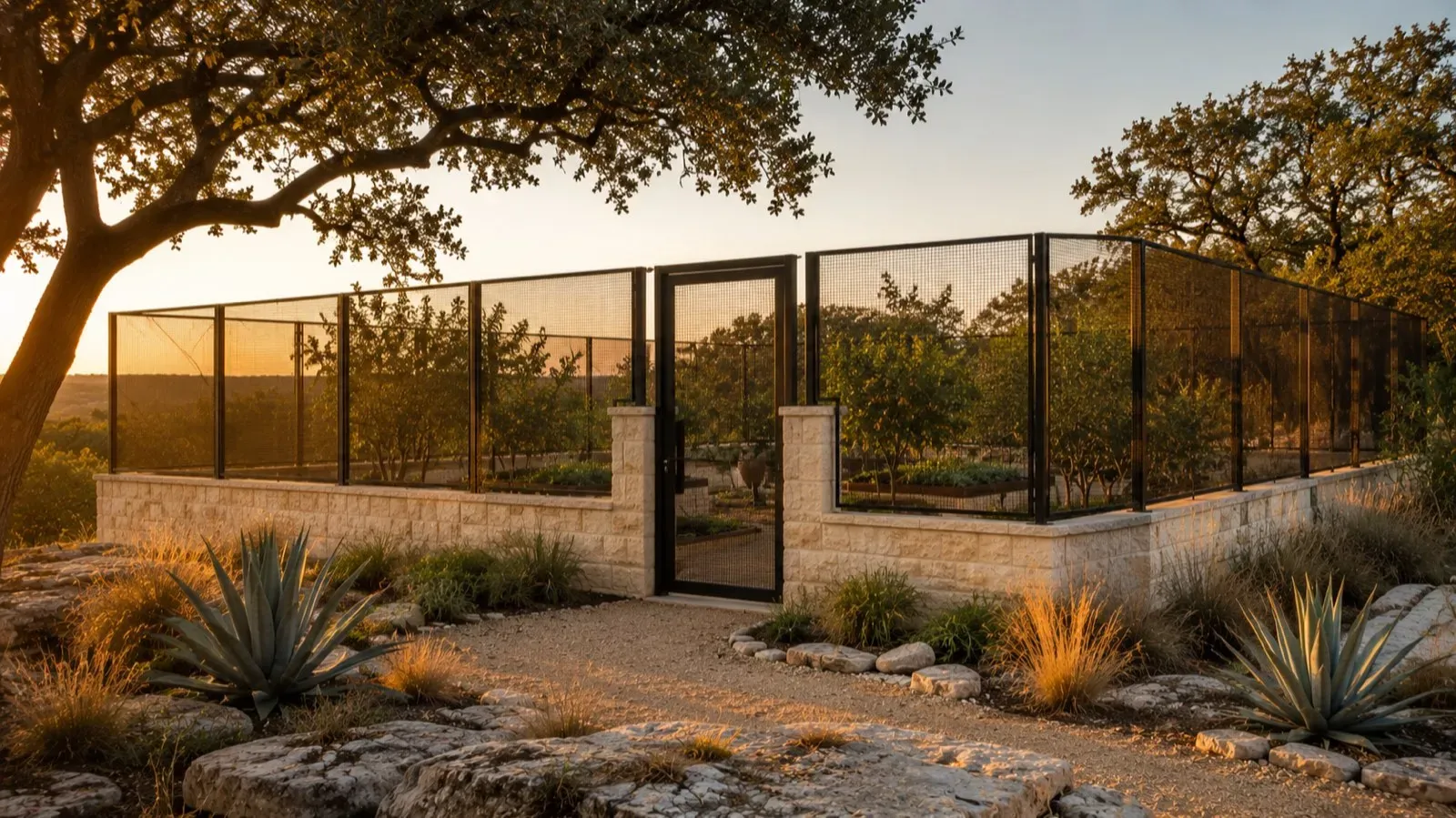
Deer pressure across the Hill Country is severe and constant. A conventional passive deer-exclusion fence is commonly specified at about eight feet, with no gap at ground level, and performance still depends on terrain, gates, visibility and local pressure. Where that height is visually unwelcome, the established alternatives are a lower electrified fence, or a double fence of two shorter runs set several feet apart.
Whichever route you take, it is an architectural decision rather than a hardware one. An eight foot enclosure is a substantial object on an estate. Designed in, it becomes a walled garden, which is a handsome thing with a long history and a genuine pleasure to walk into. Added afterwards, it is a fence around a vegetable patch. The entire difference is whether it was drawn with the house.
What actually grows, and what Uri taught us
Central Texas runs two growing seasons, spring and fall, split by a summer in which open ground gets difficult. It is not that everything stops. Heat-adapted crops keep producing. But cool-season crops bolt, fruit set fails in the heat, and quality falls away. That gap is the reason a residential greenhouse is useful here: it bridges the hard middle rather than extending a winter we barely have.
For fruit, chill hours govern. Travis County sits in roughly a five hundred and fifty to eight hundred and fifty hour range depending on where you are, using the model that counts hours between thirty-two and forty-five degrees. Cultivar selection should use nearby station data and the chill model the supplier actually states. Travis County AgriLife publishes the chill hour guidance for the area.
Peaches and plums are the chill-dependent temperate fruit commonly grown here, in low and medium chill varieties. Figs, persimmons and pomegranates generally have much lower chilling requirements than peaches and plums, but requirements vary by species and cultivar, so supplier guidance still matters. Pecans bring their own cultivar, pollination, disease and space questions. Which cultivar suits your site is a separate question that turns on frost timing, drainage, alkalinity and pollination as much as on chill hours.
Cold hardiness is where the USDA map is the right tool. Current mapped locations across Austin and the surrounding Hill Country include both 8b and 9a, and USDA directs you to check the exact address rather than assume a town-wide zone. Check your actual address in the USDA tool rather than assuming your town’s zone, and treat it as what it is: a measure of average annual extreme winter minimum, useful for deciding what survives a cold night and silent on everything else.
Citrus is the tempting one and it deserves a caution grounded in something real. Winter Storm Uri in February 2021 caused substantial commercial citrus damage in the Rio Grande Valley. That happened in the Rio Grande Valley, a genuinely subtropical citrus region. Austin and the Hill Country are more marginal than that. It does not mean no citrus. It means citrus belongs somewhere protected, and if that somewhere is the greenhouse, then the greenhouse is one you can heat when a freeze of that order arrives.
What we settle at design stage
- Which plants the greenhouse is actually for, and the minimum temperature you intend to hold, because heating and glazing follow from that and nothing else.
- Where the sun falls in August rather than March, which sets orientation and shade.
- Where the raised beds go, and the drip line that serves them, before the trenches are closed.
- How the enclosure handles deer, and whether it reads as a walled garden or an afterthought.
- Whether catchment sized for the house can also serve the garden.
- Which fruit suits the chill hours, and where the frost-tender things are protected.
- What the authority having jurisdiction requires for the structure at your specific address, which is a question for your builder and design team early, not an assumption from an article.
Done together, that is a garden that belongs to the house. Done piecemeal, it is a greenhouse standing in whatever space was left over. If you are planning the wider ground plane at the same time, our guide to estate landscaping covers how the formal and productive parts of a property sit together, and what an estate lot can hold covers the structures side.
Do I need to heat a residential greenhouse in Central Texas?
Cooling is the dominant annual load here, not heating. But heating depends on what you are protecting: a house that only holds off frost is a light specification, while one keeping tender stock alive through a hard freeze needs real heating capacity and backup power. Decide the purpose first.
Why do Hill Country kitchen gardens use raised beds?
Because there is often no soil to improve. Much of the Edwards Plateau is a few inches of alkaline, low organic matter soil over limestone or caliche. Advice to till eight to ten inches and amend does not apply where rock starts sooner. Raised beds with imported soil build a growing medium rather than fixing the native profile.
Can I water a vegetable garden under Austin’s watering restrictions?
Yes, and this surprises people. Austin’s exemption list allows watering vegetable gardens with a soaker hose or drip irrigation at any time on any day, along with hand-held hose or refillable container watering. The ordinary schedules still govern the listed landscape-irrigation methods, while qualifying vegetable-garden drip or soaker watering is separately exempt. Confirm the current stage, which moves with lake levels.
How tall does a fence need to be to keep deer out?
A conventional passive deer-exclusion fence is commonly specified at about eight feet, with no gap at ground level. Performance still depends on terrain, gates, fence visibility and local deer pressure. Where that height is unwelcome visually, a lower electrified fence or a double fence of two shorter runs set several feet apart are the established alternatives.
What fruit trees actually work here?
Travis County sits in roughly a five hundred and fifty to eight hundred and fifty chill hour range. Low and medium chill peaches and plums are commonly selected against local chill data. Figs, persimmons, pomegranates and pecans are also grown here, but each has separate cultivar, chill, pollination, disease and site requirements. Cultivar selection depends on your specific site, since frost timing, drainage, alkalinity and pollination matter as much as chill hours.
What size and type of greenhouse should I build?
It follows from the crops and the temperature you intend to hold, which is the input most people skip. Those decisions set the glazing, the ventilation area, the shade strategy and whether you need heat and backup power. Anyone specifying a structure before knowing them is selling you a shape.
If you are planning a Hill Country home and want a residential greenhouse and kitchen garden that belong to the house rather than sitting beside it, start a conversation with our team, and we will design the ground plane and the structures together from the beginning.
Planning a custom home?
Our architects and builders work as one team, from the first conversation to the day you move in.