
Backyard Putting Green: What to Settle Before You Build

Three holes, or one? That is usually the second question. The first one, and the one that decides whether you get either, is where the green can physically go, and on an Austin estate lot that is settled long before anyone stands in the yard with a tape measure.
A backyard putting green is one of the more enjoyable things we design and one of the easier things to get wrong. Not the surface. Surface installation is a specialist scope in its own right. The position, the size, and the shape of the ground around it are what separate a green you use most evenings from an ornament you walk past.
We build in Austin and across the Hill Country, including in Travis Club and near Driftwood Golf and Ranch Club. This is the builder’s version of the subject.
What makes a backyard putting green good rather than just present
Start here, because most articles never do.
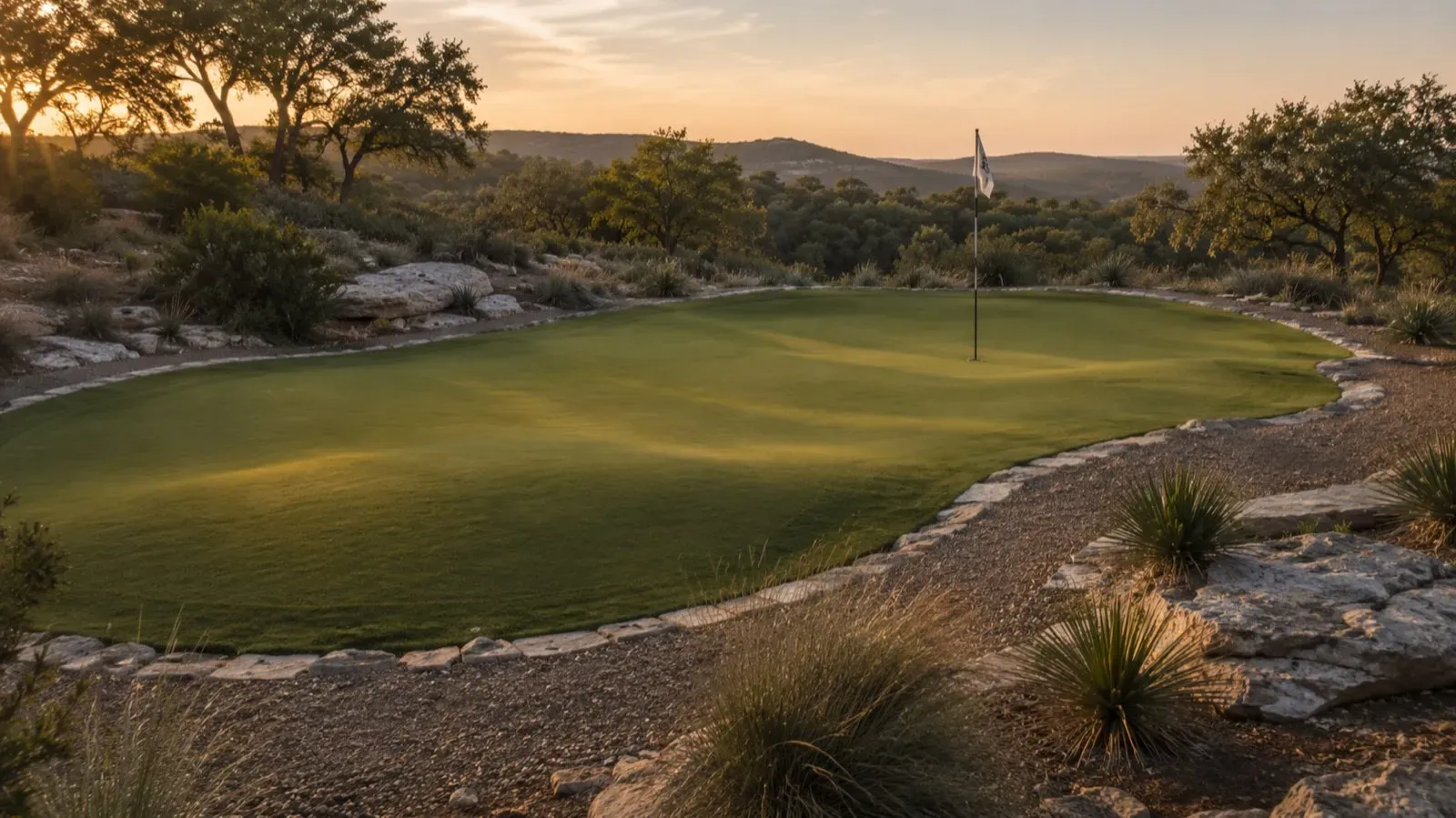
Size. A green needs enough surface to hold a ball on more than one line. Too small and every putt is the same putt, which is the fastest way to stop using it. The useful question is not square footage in the abstract, it is how many genuinely different putts the green offers from its perimeter. Three or four distinct looks is a green you keep coming back to.
Break. This is where owners overreach. Dramatic contour photographs well and plays badly. A green with too much movement turns every putt into a novelty, and novelty wears out. Enough fall to make the read interesting, gentle enough that a good putt is rewarded, and at least one flat area you can practise a straight three-footer on, because that is the putt that actually matters.
One hole or several. Several, if the size supports it, but placed so they play differently, not just spaced out. A hole tucked near a slope, one on a shelf, one open. Otherwise you have built one hole with spare cups.
The surround. The most overlooked decision. If you want to chip, the ground approaching the green matters as much as the green does, and it needs a landing area that will take a divot or a bounce without looking wrecked. This is also the safety question. Decide early where a mishit ball goes, because the answer is usually toward glass.
The sight line. A green you can see from the kitchen or the terrace gets used. A green around the corner does not. That is not a golf decision, it is a plan decision, which is exactly why it belongs on the drawing rather than in the yard.
Light. Most of the year in Central Texas the pleasant hour to putt is after the sun drops. Lighting means conduit, and conduit means a trench, and there is exactly one moment when that trench is already open.
The one decision that shapes everything after it
Is the green part of the build, or a later addition?
Designed in, a backyard putting green is a grading problem you solve once, while the excavator is on site and the drawings are open. Added later, it becomes a negotiation with decisions that have already hardened. The surface need not be worse, but the available design options usually are. It gets smaller, flatter, further from where you wanted it, and sometimes it does not happen at all.
Drainage, and where the water actually goes
The playing surface is the last inch of the assembly and the least interesting part of it. A green is really a drainage structure wearing a putting surface.
It needs a prepared, compacted base that sheds water in a direction you chose, and somewhere for that water to go. On Hill Country ground that second half is the hard half. Thin soil over limestone does not take water the way a deep suburban profile does, and the City of Austin’s development guidance is explicit that karst features should be surveyed and recorded with a buffer identified rather than found during construction.
Three things set how deep the assembly has to be: the soil profile you are building on, how much fall you have to work with, and what the installer will warrant. We do not publish a number, because a number without those three is a guess about your lot made by someone who has not seen it.
Grass or synthetic, fairly
Here is the comparison stated honestly, because the version most articles run is rigged.
The natural surface on a Central Texas course is generally not bentgrass. Bentgrass is a cool-season grass, and the USGA’s agronomy guidance shows what it demands even in a suitable climate: mowing around a tenth to fifteen hundredths of an inch, raised under heat stress, with aeration, vertical mowing, sand topdressing and disease pressure. At backyard scale in Central Texas that is usually a losing argument. The warm-season ultradwarf bermudagrasses are what southern courses actually putt on, and if you play here, you have been putting on them all along.
So the real comparison is ultradwarf bermuda against synthetic, and it is closer than the marketing on either side suggests. Ultradwarf gives you a genuine putting surface that behaves like the greens you play. It also wants specialist mowing equipment at a height a domestic mower cannot reach, frequent attention through the growing season, and a decision every autumn about dormancy and whether to overseed. At backyard scale that is a smaller version of a full agronomy program, not an escape from one.
| Criterion | Ultradwarf bermudagrass | Synthetic |
|---|---|---|
| Feel underfoot and roll | Plays like the greens you know | Close, not identical |
| Mowing | Specialist equipment, below domestic mower height | None |
| Water, Austin Water customers | Potable irrigation is subject to method-specific schedules; exemptions may apply to auxiliary water | No irrigation needed for plant survival; occasional cleaning or cooling may still use water |
| Through the year | Dormant in cold weather; optional overseeding adds management | Retains color, but condition and performance still change with heat, wear, aging and maintenance |
| In direct summer sun | Cools itself | Runs hotter |
Synthetic greatly reduces mowing and routine irrigation, substituting cleaning and periodic surface maintenance, and gives up some of the feel. It also runs hotter than living grass in direct sun, because grass cools itself through evapotranspiration and plastic does not. On a west-facing green with no canopy in July, that is a real thing you notice standing on it, which is an argument for orientation and afternoon shade rather than against synthetic.
On water, the current rules are specific and they favor synthetic. For Austin Water customers, Conservation Stage restrictions have been in force since September 2025. Under them, residential automatic and manual irrigation systems run one day a week within set hours, hose-end sprinklers and drip run two days a week, and watering with a hand-held hose or refillable container is allowed at any time. A synthetic green needs no routine irrigation to survive, so it sits outside that schedule entirely. Stages move with the Highland Lakes, so check the current one rather than trusting any article, this one included.
The lot decides where it goes
Two constraints settle the position more often than anything else, and both are cheaper to discover on a survey than with an excavator.
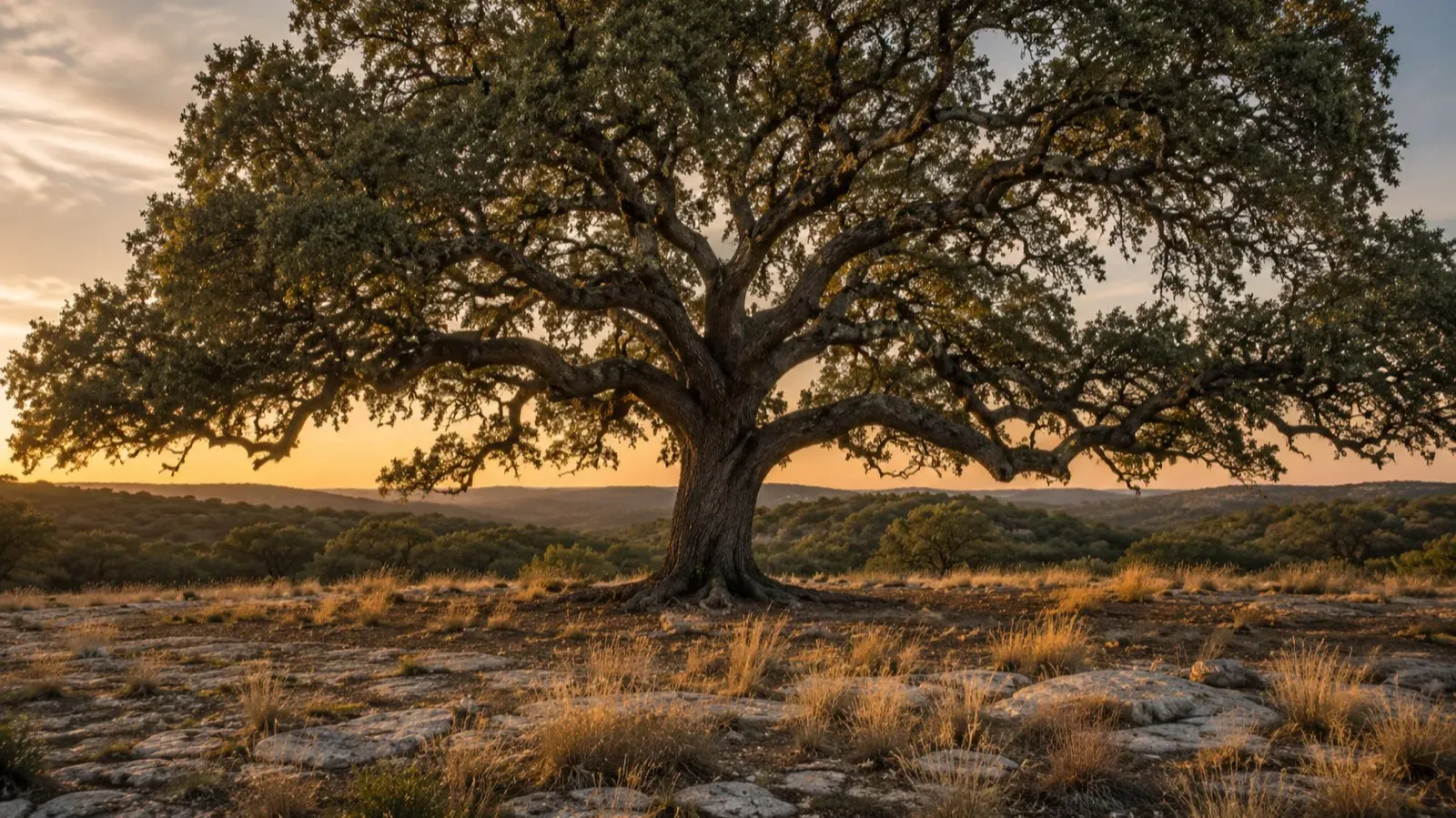
The trees. Austin regulates trees on private property in tiers, and the tiers get mixed up constantly, including by people who should know better. Diameter is measured under Austin’s prescribed method, generally at four and a half feet above ground, and borderline or multi-stem trunks belong with an arborist rather than a tape measure. Trees nineteen inches in diameter and larger are Protected Trees, of any species, and a permit is required to remove or impact them.
Trees twenty-four inches and larger may be Heritage Trees, a narrower category applying to a listed set of species that includes all oaks, pecan, cedar elm, bald cypress and eastern black walnut, where impacts beyond what the code allows need a variance. For a Heritage Tree at least thirty inches in diameter, a proposed variance must go through the applicable public process. The City Arborist’s own page sets the tiers out.
Protection is organized around the critical root zone. The City’s basic calculation for a normally measured tree is a radius in feet equal to the trunk’s diameter in inches, with restrictions tightening closer to the trunk, and the survey and preservation plan have to apply Austin’s own measurement and review criteria rather than a radius staked off an informal measurement. These are preservation criteria assessed at review, not flat prohibitions, which is exactly why they are a design conversation.
The practical point: a mature live oak over twenty-four inches is a Heritage Tree, and mature live oaks like to stand on the flat, open, handsome ground where a green wants to be.
This is Austin’s ordinance. Bee Cave and Lakeway are separate municipalities with their own rules, unincorporated county land is different again, and private communities add their own controls. Confirm what governs your address rather than assuming.
The wastewater system. A property outside a utility service area may rely on an on-site sewage facility, and you do not build over one. Not just the disposal area: the treatment units, the disposal field, the reserve area where required, the setbacks, and the access needed to service all of it. Where those sit is worked out early from the soil evaluation and is not casually moved afterwards. So the green and the wastewater system compete for the same open, sunny, gently sloped ground, and the one with a permit wins. We went through that siting logic in what actually sets the cost of an aerobic septic system on acreage.
And the cover allowance. On a lot with a hard impervious cover cap, whether a synthetic green counts against it matters. The honest answer: the impervious cover calculation section of the Land Development Code, 25-8-63, and the accompanying Environmental Criteria Manual section, 1.8.1, set out what is excluded, and neither expressly names synthetic turf. That is an omission, not a ruling, and classification can turn on the assembly, the base and how it drains.
Plan for it to count until you have a written determination from the authority having jurisdiction saying otherwise, and get that during the development review that applies to your project rather than after the hardscape is committed. The much-quoted fifteen, twenty and twenty-five percent limits come from the Save Our Springs ordinance, apply within the watersheds contributing to Barton Springs, and are calculated on net site area. Your address governs. We covered how cover shapes an estate lot in what Austin estate lots allow.
In a private community, the committee still has a say
There is a claim circulating that Texas law protects a homeowner’s right to install artificial turf against an association.
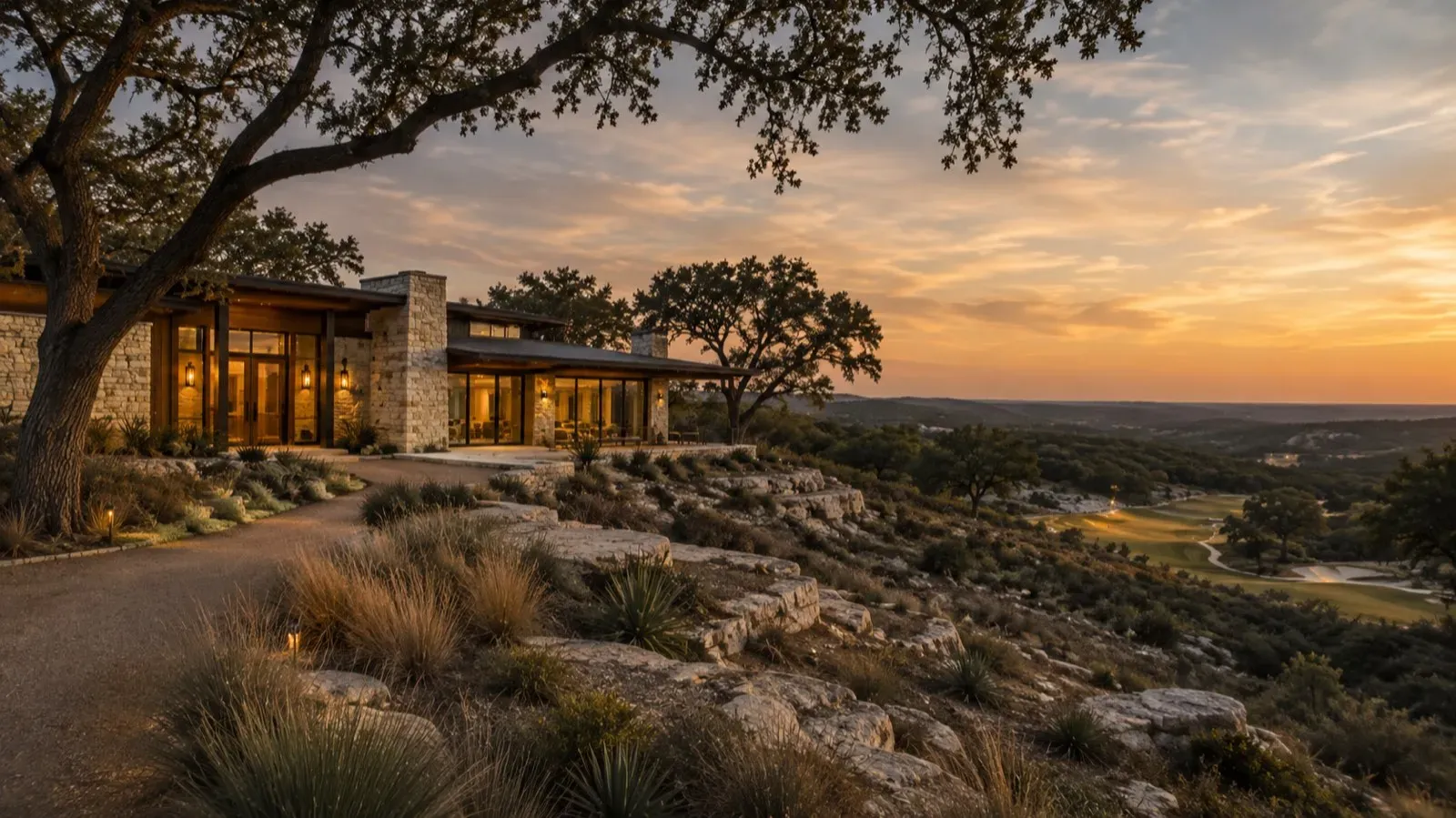
Section 202.007 of the Texas Property Code limits what an association can prohibit, and it expressly protects drought-resistant landscaping and water-conserving natural turf. It does not expressly address artificial or synthetic turf. That is what the text says. It is not a ruling that artificial turf falls outside the statute, and we are not going to pretend otherwise in either direction.
In a private club community the architectural review committee retains its approval authority over the design under the declaration and guidelines, subject to applicable law, and if your project turns on the answer, that is a question for your counsel reading your governing documents.
The builder’s advice is simpler: put the green in the original architectural submission. Approval as part of a coherent design, with grading, planting and sight lines drawn, is a much easier conversation than a variance for a finished house. We have written about the architecture at Travis Club and building at Driftwood Golf and Ranch Club.
What we settle before we draw the green
- How many genuinely different putts the green will offer, which sets the size.
- Where the regulated trees are, with critical root zones surveyed rather than estimated.
- Where the wastewater system sits in full, including reserve area and service access.
- How the green will be classified against the cover allowance, in writing.
- Where the water goes when it leaves the green.
- Which way it faces, what shades it at five in the afternoon, and what you see from the kitchen.
- Where a mishit ball ends up.
- Whether it will be lit, while the trench is still open.
All of it is cheaper resolved once, on paper. That is the case for building the green into the house rather than onto it. If you are planning the wider ground plane, our guide to outdoor living design that actually gets used covers how the pieces fit.
Does a backyard putting green count against impervious cover in Austin?
The code’s impervious cover exclusions do not expressly name synthetic turf, so it is not settled in advance. Plan for it to count until you have a written determination from the authority having jurisdiction, obtained during your project’s development review, before the hardscape is committed.
Can I build a putting green over my septic system?
A green should not be placed over or within the required areas of an on-site sewage facility unless the licensed designer and the permitting authority expressly approve the proposed assembly and the access arrangement. Those required areas include the treatment units, the disposal area, the reserve area where one is required, setbacks and service access, not just the visible part. The layout is worked out early from the soil evaluation, so on acreage this is usually what decides where a green can go.
Synthetic or real grass for a backyard putting green here?
The natural choice in Central Texas is an ultradwarf bermudagrass, not bentgrass, which is a cool-season grass unsuited to this heat. Ultradwarf plays like the greens you know but needs specialist mowing, frequent attention and an annual dormancy decision. Synthetic eliminates mowing and routine irrigation for plant survival, but still needs cleaning and periodic surface maintenance, gives up some feel, and runs hotter in direct sun.
Does Texas law stop my HOA from restricting artificial turf?
Not clearly. Section 202.007 of the Texas Property Code expressly protects drought-resistant landscaping and water-conserving natural turf, and does not expressly address artificial turf. If your project depends on the answer, have counsel read the statute against your governing documents and get approval in writing.
How do live oaks affect where a green can go?
Austin protects trees in tiers. Nineteen inches and above are Protected Trees of any species. Twenty-four inches and above may be Heritage Trees, a listed group that includes all oaks. Austin’s basic plan calculation for a normally measured tree uses a critical root zone radius in feet equal to trunk diameter in inches, with the City’s prescribed measurement and review criteria controlling. Mature oaks often hold the flattest ground, so survey before you lay out.
How big should a backyard putting green be?
Big enough to offer three or four genuinely different putts from its perimeter. Below that every putt repeats and the green stops getting used. Contour matters more than raw area: enough fall to make a read interesting, plus one flat area for straight short putts, which are the ones worth practising.
If you are planning a home on an estate lot and a backyard putting green is on the list, raise it while the site plan is still a drawing. Start a conversation with our team, and we will work out where it can go, and how good it can be, before anything is poured.
Planning a custom home?
Our architects and builders work as one team, from the first conversation to the day you move in.