
Austin Heritage Tree Ordinance: Designing a Custom Home Around Protected Trees

The live oaks on an established lot in Tarrytown or the west Austin hills are often what made the lot worth buying. The harder question comes next: can that lot hold the house you want without losing them? Inside the City of Austin, the Austin heritage tree ordinance and the root zone rules that come with it answer much of that question before an architect draws a room.
That is why, on a lot with mature oaks, pecans, or cedar elms, the tree survey and the root zone map come before the floor plan, not after it. Understanding the Austin heritage tree ordinance early keeps a design from being redrawn around a tree nobody mapped.
What Does the Austin Heritage Tree Ordinance Protect?
Measured 4.5 feet above grade, any Austin tree 19 inches or larger in diameter on residential property is protected. A heritage tree is 24 inches or larger and one of the listed species, including all oaks, pecans, bald cypress, cedar elm, and eastern black walnut.
The rest of the heritage list is Texas ash, American elm, Texas madrone, bigtooth maple, and Arizona walnut. Below 19 inches, the City’s own guidance is direct: trees less than 19 inches in diameter are not regulated on residential property. A multi-trunk tree is measured as the largest trunk’s diameter plus half the diameter of each additional trunk one inch or larger.
| Tier | Size | Species | What It Means for a Residential Lot |
|---|---|---|---|
| Not regulated | Under 19 inches | Any species | Not regulated by the City on residential property |
| Protected | 19 inches and larger | All species | Permit required for removal or impacts |
| Heritage | 24 inches and larger | Listed species only, including all oaks and pecans | Removal generally requires an approved variance; a narrow emergency exception applies |
How the Austin Heritage Tree Ordinance Handles Removal
Under Section 25-8-641, heritage tree removal generally requires a permit and an approved variance. A narrow exception allows removal without a variance when a damaged heritage tree poses an imminent hazard to life or property and is removed within seven days of the damage. Thirty inches does not create a new tree class. It decides who hears the request: a heritage tree with no stem 30 inches or larger goes to an administrative variance decided by City staff, while a tree with at least one stem 30 inches or larger, measured at 4.5 feet, goes to the Land Use Commission, a public process.
For a healthy tree, either route asks the same hard questions first. The applicant must have sought and been denied other relief under the code that would avoid removing the tree, and the need for removal cannot come from the way the owner chose to develop the property, with a limited exception.
An administrative variance carries no application fee or mitigation requirement when the City finds the tree dead, an imminent hazard that cannot reasonably be mitigated without removal, or diseased with recovery impracticable or a risk of spread. A healthy heritage tree that is simply in the way is another matter. There is no guarantee a variance will be granted, and a plan that depends on one rests on an outcome no one on the project controls. On a lot worth building on, the house gets designed around the tree, not the other way around.
The Critical Root Zone Decides the Footprint
Every regulated tree, protected or heritage, carries a critical root zone, and Austin’s Environmental Criteria Manual sets the rules for it. The critical root zone is a circle centered on the trunk, with a radius in feet equal to the tree’s diameter in inches. A 30-inch heritage oak has a critical root zone with a 30-foot radius.
Inside that circle sits the Half CRZ, a 15-foot radius in this example, which must be protected except for cut or fill of 4 inches or less. Inside the Half CRZ is the Quarter CRZ, a 7.5-foot radius, where no cut or fill is allowed at all. Across the whole critical root zone, at least half the area must stay at natural grade with natural ground cover.
Removal is broader than cutting a tree down. The code counts damaging the root system and excessive pruning as removal, and the criteria manual treats taking more than 25 percent of a regulated tree’s foliage in one growing season as excessive. The root zone is also a circle, not a lot line, so a neighbor’s tree near the property line can place part of its critical root zone on the lot being designed, and it belongs on the site map from day one.
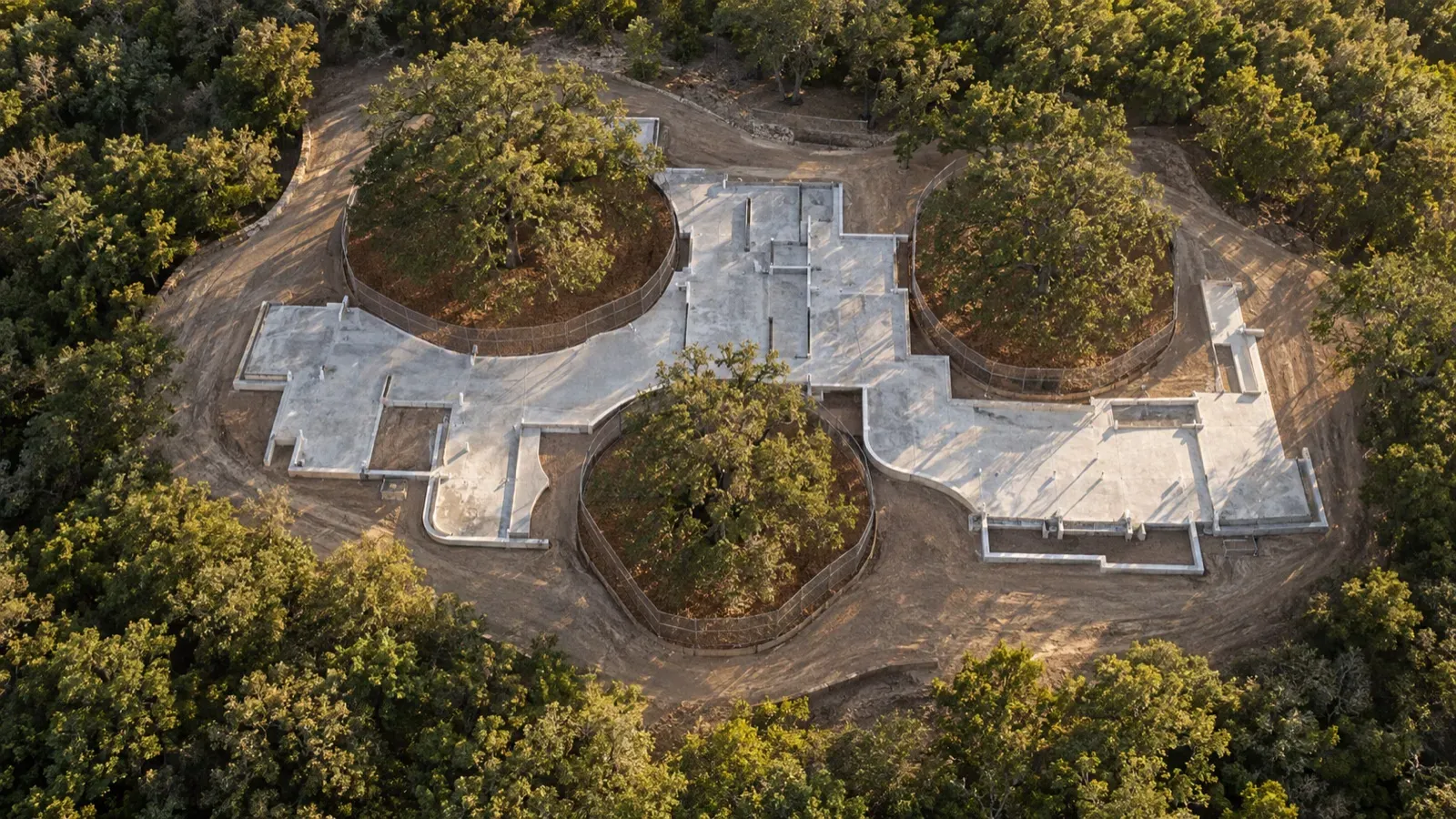
The House, Pool, Driveway and Utilities Compete for the Same Ground
On an acre-scale west Austin lot, a mature canopy may not leave one obvious building envelope. The architect is weighing the house footprint, a courtyard or motor court, the pool, a septic or sewer line, and whatever critical root zones the Austin heritage tree ordinance has already claimed. This is site-specific design in the most literal sense: the plan responds to what is already standing on the ground.
Pier foundations get considered where the alternative is excavating through a root zone the survey says has to stay intact. A pier system does not clear a root zone conflict on its own, and our guide to pier and beam versus slab foundations covers how foundation type actually interacts with roots near a build site.
Driveway and motor court routing often bends around a heritage oak rather than through it. Utility and septic trenching gets routed around root zones where the site allows, and toward their outer edges where it does not. Grade changes near a protected canopy get modeled before they get built. Equipment parking, material storage, and the crane pad get placed at the design stage too, because they disturb the ground as surely as the house does.
Six Steps Before You Design
Before a single elevation gets drawn, working through the Austin heritage tree ordinance in this order keeps a project from doubling back on itself.
- Confirm jurisdiction by parcel, not mailing address. An Austin mailing address does not always mean Austin’s ordinance applies, and that distinction matters most for a build on your own lot near a city boundary.
- Commission a tree survey. In Austin, applications for one- and two-unit residential projects require a survey of all trees 19 inches in diameter and larger.
- Get an arborist’s health assessment of every tree the survey flags, since a tree already in decline changes what is realistically preservable.
- Map every critical root zone onto the buildable envelope, alongside setbacks and impervious cover limits, before the first floor plan sketch.
- Test alternative footprints against that map, rather than drawing one plan and hoping it clears review.
- Build the tree protection plan and the permit path early. Tree review under the Austin heritage tree ordinance runs alongside building plan review, and the tree permit accompanies the residential building permit rather than trailing behind it.
Protecting Trees During Construction
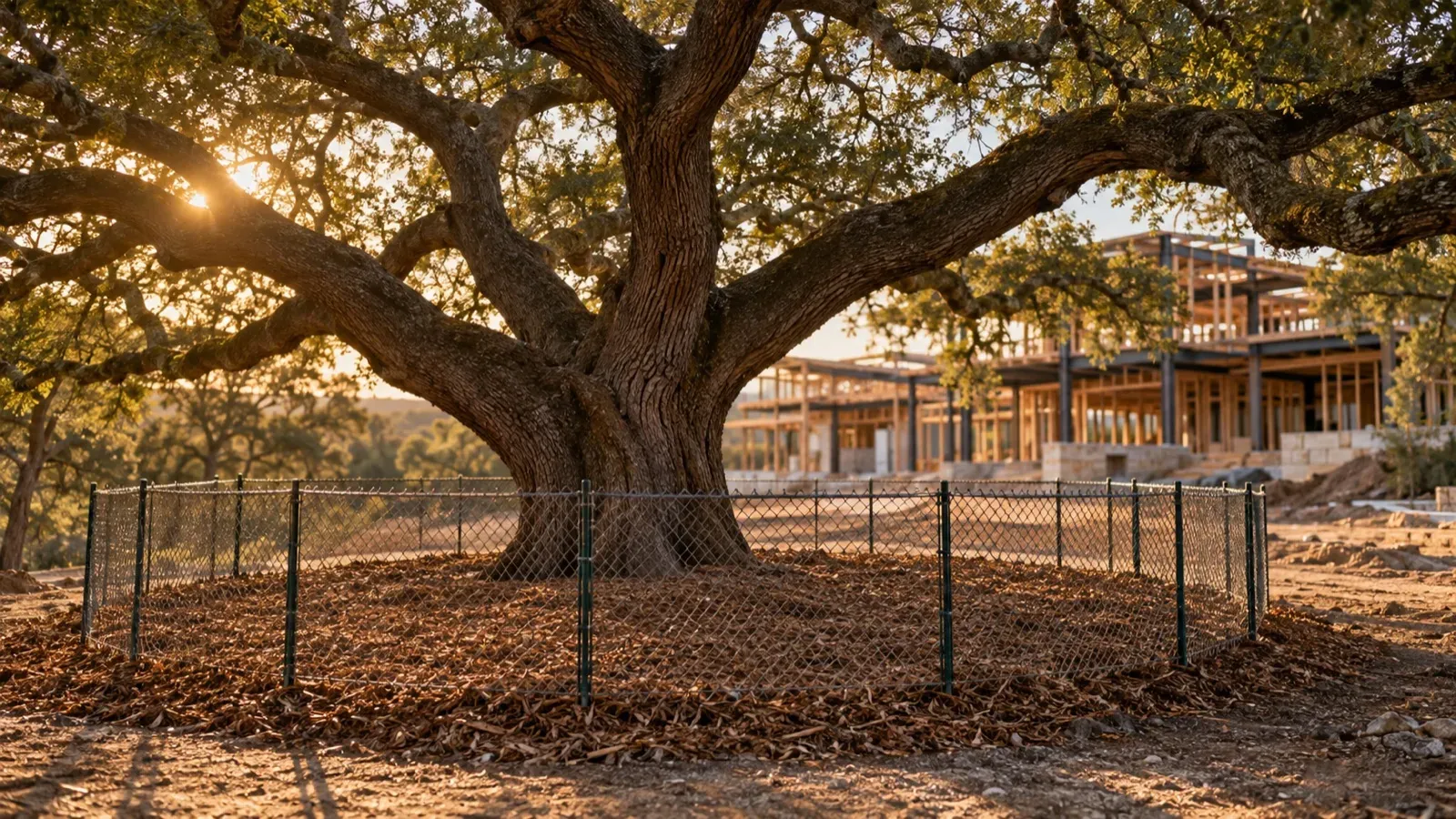
A design that respects the Austin heritage tree ordinance on paper still has to survive a construction site, and the City’s protection standards are specific. Tree fencing must be chain-link mesh at least 5 feet high, set on steel T-posts no more than 10 feet apart. Plastic fencing is not permitted. Where fencing sits 5 feet or closer to a trunk, the first 8 feet of that trunk gets wrapped.
Unfenced portions of the critical root zone require 8 to 12 inches of mulch unless covered by existing hardscape or approved for impacts. Inside the fence, bare or disturbed soil gets a 3-inch layer, and mulch is never piled against the trunk.
Oak wilt is a separate risk, and the guidance here comes from Texas A&M Forest Service, not the City’s construction standards: avoid pruning or wounding oaks from February through June, and paint any wound on an oak immediately, year round. Live oaks have interconnected root systems that can stretch for hundreds of feet, and the disease can move underground through those connections, so one infected tree can put its neighbors at risk.
Outside the City of Austin, the Rules Change
The Austin heritage tree ordinance only governs land inside Austin’s jurisdiction, and each nearby city below sets its own rules with different numbers. In West Lake Hills, both the numbers and the mechanism differ. Even a tree under 10 inches needs a permit to remove, and removing a tree 14 inches or larger is prohibited unless it is dead or dying under the city’s definition; otherwise it takes a variance from the city council.
Bee Cave regulates far more of the canopy, with four tiers starting at 4 inches and a heritage class at 24 inches and larger regardless of species. In Bee Cave, a permit to remove an oak is not valid from February 1 through July 1. Lakeway protects hardwood trees 12 inches and larger, under an ordinance amended in October 2025.
Rollingwood updated its residential landscaping and tree canopy ordinance in April 2025. Unincorporated Travis County has no general tree preservation ordinance for the interior of a private lot, though county rules do reach trees in county right of way and easements. That is why step one is confirming jurisdiction by parcel.
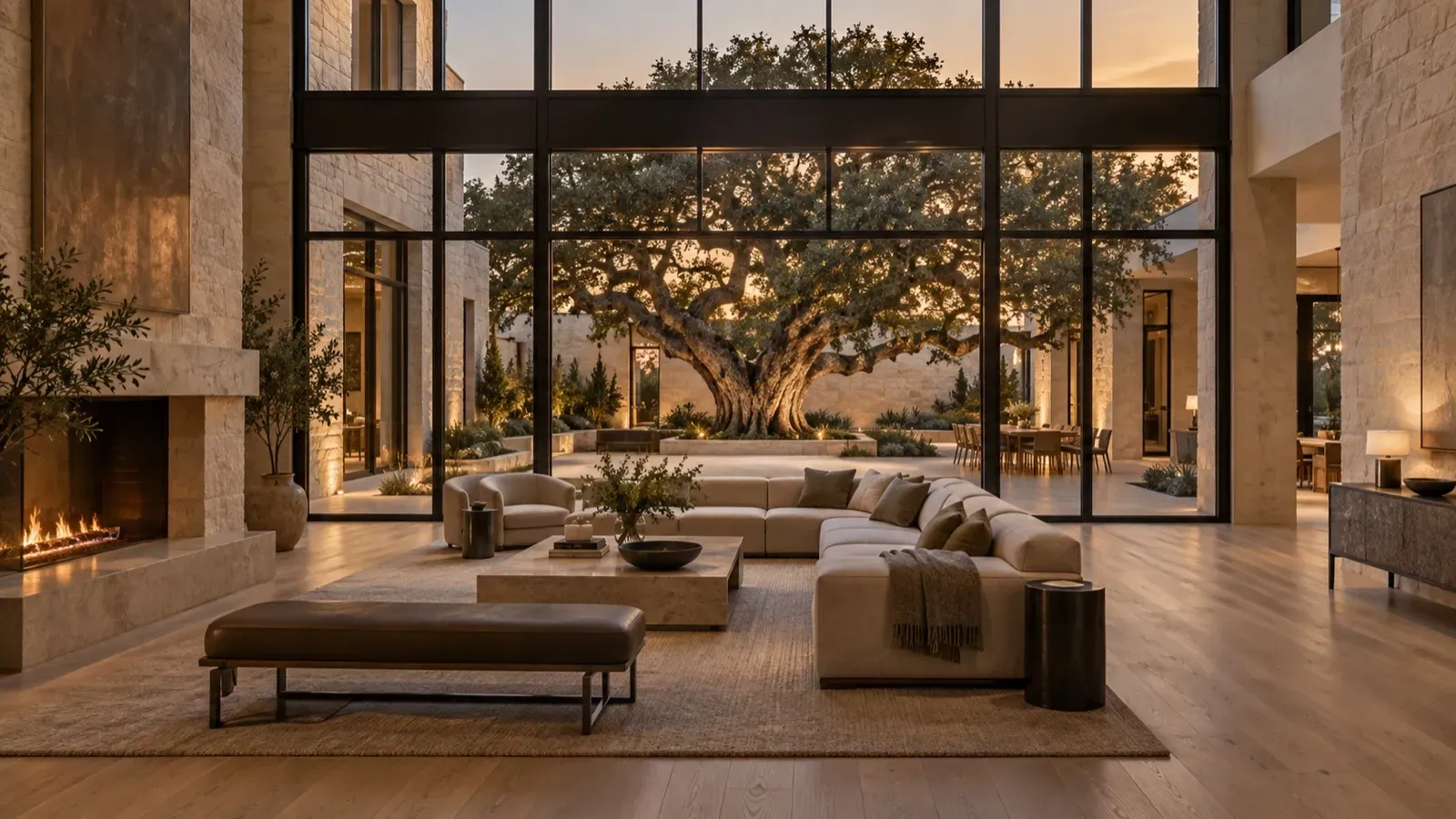
Working with the Austin heritage tree ordinance is a design brief, not an obstacle to argue around. The trees that make a lot worth buying are usually the same trees the ordinance is built to protect, and the two goals tend to point the same direction. No survey, arborist, or design decision can guarantee that every tree on a lot survives construction, but a plan built around the canopy from the first sketch gives every tree its best chance. This summary reflects each jurisdiction’s published rules as of September 2026, and the city or county that governs the parcel has the final word.
What is a heritage tree in Austin?
A heritage tree under the Austin heritage tree ordinance is 24 inches or larger in diameter, measured 4.5 feet above the ground, and applies only to a specific list of species: all oaks, pecans, bald cypress, cedar elm, eastern black walnut, Texas ash, American elm, Texas madrone, bigtooth maple, and Arizona walnut. A tree of the same size in a different species is a protected tree, not a heritage tree, with different rules.
Can you remove a heritage tree to build a house in Austin?
Removal to make room for a house requires an approved variance. A heritage tree with a stem 30 inches or larger goes to the Land Use Commission; smaller heritage trees go to an administrative variance. For a healthy tree, the owner must first seek other code relief that would avoid removal. A tree the City Arborist finds dead or an imminent hazard that cannot reasonably be mitigated without removal can qualify for an administrative variance regardless of size.
How big is a tree’s critical root zone?
A critical root zone is a circle around the trunk with a radius in feet equal to the tree’s diameter in inches, so a 24-inch heritage tree has a critical root zone with a 24-foot radius. At least half of that area must stay at natural grade, the Half CRZ allows cut or fill of only 4 inches or less, and the innermost Quarter CRZ allows none at all.
Do I need a tree survey to build a custom home in Austin?
Inside the City of Austin, yes. Applications for one- and two-unit residential projects require a survey of all trees 19 inches in diameter and larger. That survey, not the listing photos, is what tells an architect where the Austin heritage tree ordinance actually limits the buildable envelope.
Does the Austin heritage tree ordinance apply in West Lake Hills or Lakeway?
No. Each surrounding city sets its own tree rules. In West Lake Hills, even a tree under 10 inches needs a permit to remove, and a tree 14 inches or larger cannot be removed unless it is dead or dying or the city council grants a variance. Lakeway protects hardwood trees 12 inches and larger under an ordinance amended in October 2025. An Austin mailing address does not tell you which set of rules governs a given lot.
When is the best time to prune oaks?
Texas A&M Forest Service recommends avoiding any pruning or wounding of oak trees from February through June, and painting any wound to an oak immediately, year round. Its general guidance is that the best time to prune trees is during dormancy, November through January, when fewer insects and diseases are present. In Austin, taking more than 25 percent of a regulated tree’s foliage in a growing season counts as removal.
If you own a lot with trees worth keeping and want to know what it can hold, start a conversation with our team, and we will walk the survey, the root zones, and the design options with you before the first line gets drawn.
Planning a custom home?
Our architects and builders work as one team, from the first conversation to the day you move in.