
Ag Exemption and Wildlife Valuation on Hill Country Acreage: What Changes When You Build the House

The listing says the land has an ag exemption, and you plan to build a house on it. Before anything is designed, find out what the house does to the tax appraisal in Travis, Hays or Blanco County. If you are still looking for acreage, start with our guide to ranchette communities near Austin.
Quick answer: what people call an ag exemption is a special appraisal on the land’s productive value. The house is appraised at market value on a homesite the appraisal district sets, and the acres left in agricultural appraisal must still meet the district’s standard. A change to a non-qualifying use generally triggers a rollback tax of up to three years of tax difference, with no interest on the rollback for changes since June 15, 2021 unless the bill goes delinquent. Apply before May 1, in practice by April 30.
What People Mean by Ag Exemption
Texas Parks and Wildlife (TPWD) says there is no “agricultural exemption” or “wildlife exemption” for open-space land. These properties “are subject to property taxation but based on the land’s productive value rather than market value as required by Section 1-d-1,” according to the TPWD legal summary. Travis CAD’s FAQ agrees: “An Agriculture Exemption is not an exemption, but rather a special valuation.”
The rules sit in Article VIII, Section 1-d-1 of the Texas Constitution and Tax Code Chapter 23, Subchapter D. Section 23.52(d) requires appraisal offices to use the Comptroller’s appraisal manual, quoted here from its October 2024 edition (a 2026 revision has been proposed).
The Tests the Land Has to Pass
Section 23.51(1) defines qualified open-space land as land “currently devoted principally to agricultural use to the degree of intensity generally accepted in the area” that has been devoted principally to agricultural use “or to production of timber or forest products for five of the preceding seven years.” The land must qualify on January 1.
When land has more than one use, the manual says “the most important or primary use must be for agricultural use.” The intensity test applies to the year of application and every year after. Land inside city limits faces added conditions under Section 23.56, so ask the district first.
Degree of Intensity: Each District Sets Its Own Number
The manual says “There is no minimum or maximum amount of acreage that may qualify for special appraisal (except for beekeeping),” and tells chief appraisers to set the standard by the agricultural practices in the area. For livestock, Travis, Hays and Blanco publish animal-unit guidelines; hay, orchards and beekeeping have their own standards.
| County | Livestock guideline | Standard wildlife minimum, tract reduced in size | Homesite treatment | Document |
|---|---|---|---|---|
| Travis | 4 animal units run year-round on pastureland | 20.0 acres | Standardizes a minimum of one acre; may assign more | Guidelines, Rev. 10.2024 |
| Hays | 3 animal units | 14.29 acres | Survey (residence on less than an acre), homestead application (up to 20 acres) or field inspection | Guidelines, updated 12/31/2024 |
| Blanco | Enough acres for 2 animal units | 20.00 acres if subdivided during the previous year | No acreage figure in its 2026 guidelines; ask the district | Guidelines, amended for the 2026 tax year |
The figures come from the guidelines of Travis CAD, Hays CAD and Blanco CAD; ask for the current version. Lower wildlife minimums apply to wildlife management associations and some endangered-species tracts. Acres per unit vary by land type, so the acreage you need varies by county and by the ground.
Small tracts get a closer look: Blanco CAD says the primary uses of any tract of 10 acres or less “will generally be considered residential.”
Wildlife Management Valuation
Wildlife management is an agricultural use under Section 23.51(2), so wildlife valuation keeps an existing agricultural appraisal with wildlife practices in place of livestock or crops. TPWD calls it revenue neutral. Under Section 23.51(7)(A), it means actively using the land in at least three of seven ways to propagate a sustaining breeding, migrating or wintering population of indigenous wild animals: habitat control, erosion control, predator control, supplemental water, supplemental food, shelters and census counts. Wildlife management must stay the land’s primary use.
Two preconditions catch buyers. First, the statute requires that the land was appraised as qualified open-space land (or timber land) when the wildlife use began, and Hays CAD says you “must start with traditional 1d1 Agricultural Use.” In practice, raw land with no agricultural appraisal cannot go straight to wildlife valuation. Second, you file a wildlife management plan on the TPWD form (PWD 885-W7000) with the appraisal district, not with TPWD, along with a new application. Travis CAD also requires an annual report by the last day of February and says a missing or inadequate report will remove the wildlife designation, while the Comptroller’s wildlife guidelines say no penalty or late fee may be assessed when a report is filed late.
A minimum acreage applies only when the tract has shrunk. TPWD says there is none “unless the tract of land has been reduced in acreage since January 1 of the preceding tax year,” so a lot split from a larger parcel can face one. The Comptroller’s guidelines place all three counties in the Edwards Plateau (Eastern) region, whose percentage range they convert to about 14.3 to 20 acres. Each district picks its number within it.

Building a House on Land With an Ag Exemption
The manual says agricultural appraisal “applies only to land and appurtenances. It does not apply to improvements on land.” So the house is appraised at market value, on land the district assigns to it.
Travis CAD’s guidelines say home sites “do not qualify for open-space valuation due to primary use” and have their own land record at market value. TCAD “standardizes a minimum of one acre for a home site on agricultural parcels and may determine a larger home site area” based on the residential and accessory improvements and the use of the land around them. Hays CAD may use the acreage on a survey when the residence was surveyed with less than an acre, the acreage on your homestead application (up to 20 acres), or, if you specify nothing, an inspection of whether the area with a residence is “fenced or ‘marked’ by roads or landscaping.” Blanco’s guidelines give no homesite acreage, so call the district.
The rollback is limited to the part that changes. Under Section 23.55(d), if the change of use “applies to only part of a parcel,” the additional tax “applies only to that part of the parcel.” The acres that stay in agricultural appraisal still face the intensity test every year, so ask the district whether it will judge the remainder on its own or as part of a larger operation.
Homestead Claims and the Three-Year Condition
Section 23.55(i) says the use of land does not change “solely because the owner of the land claims it as part of his residence homestead.” The Comptroller’s manual says an owner who builds a residence homestead on formerly qualified land “avoids rollback only as long as he or she continues to use the home as a residence,” that selling the home may trigger a rollback on the homestead land, and that “In effect, the property owner must occupy the house for three years to avoid a rollback tax accruing for the years the land was not taxed at market value.” Travis CAD’s FAQ answers a buyer who builds: no rollback “if he or she intends to homestead that property (up to 20 acres) and maintains that homestead for 3 years.”
No source names the date construction becomes a change of use or how the three years are measured, so ask the district in writing how it will treat each structure on your plan.
The residence homestead exemption in Tax Code Section 11.13(j)(1) is a separate, real exemption, and its definition includes land “not to exceed 20 acres.” That cap is not a homesite rule, though Hays CAD may use the acreage on your homestead application.

The Rollback Tax: Current Law
Section 23.55(a) imposes an additional tax equal to the difference between the taxes imposed for “each of the three years preceding the year in which the change of use occurs that the land was appraised” under the subchapter and the tax at market value. That is up to three years, fewer if the land was appraised this way for less time. HB 1743 (2019) cut the lookback from five years to three, and HB 3833 removed the interest for a change of use on or after June 15, 2021. Under Section 23.55(e), interest and penalties arise only if the bill goes delinquent.
A sale alone does not trigger a 1-d-1 rollback, the manual says.
If you take part of the land out of agricultural use to build, Section 23.54(h) requires written notice to the appraisal office before May 1 after eligibility ends. Without it, a penalty of 10 percent of the tax difference applies for each year the land was erroneously allowed appraisal.
Filing: April 30 and New Owners
Section 23.54(d) requires the application before May 1, which in practice means by April 30. District wording varies (Hays says until May 1, Blanco says before April 30), and the statute governs. The application is Form 50-129, filed with the appraisal district, not the Comptroller. Under Section 23.541, a late application is ordinarily accepted until the appraisal review board approves the appraisal records, usually in July, with a penalty of 10 percent of the tax difference; qualifying new owners have a later deadline and no penalty.
Appraisal continues without a new application unless ownership changes, eligibility ends or the chief appraiser asks in writing for a new one (Section 23.54(e)). Travis and Hays guidelines, written before 2026, say a new owner applies. Since January 1, 2026, HB 1244 and Section 23.54(e-1)(2) treat ownership as unchanged when the land was appraised this way the preceding year, the new owner uses it in materially the same way, and the same individuals oversee or conduct that use. A buyer who ends the agricultural use to build does not fit that description. If you are buying a continuing operation, ask the district in writing how it applies the exception.

The Design Lever: Where the Homesite Is Drawn
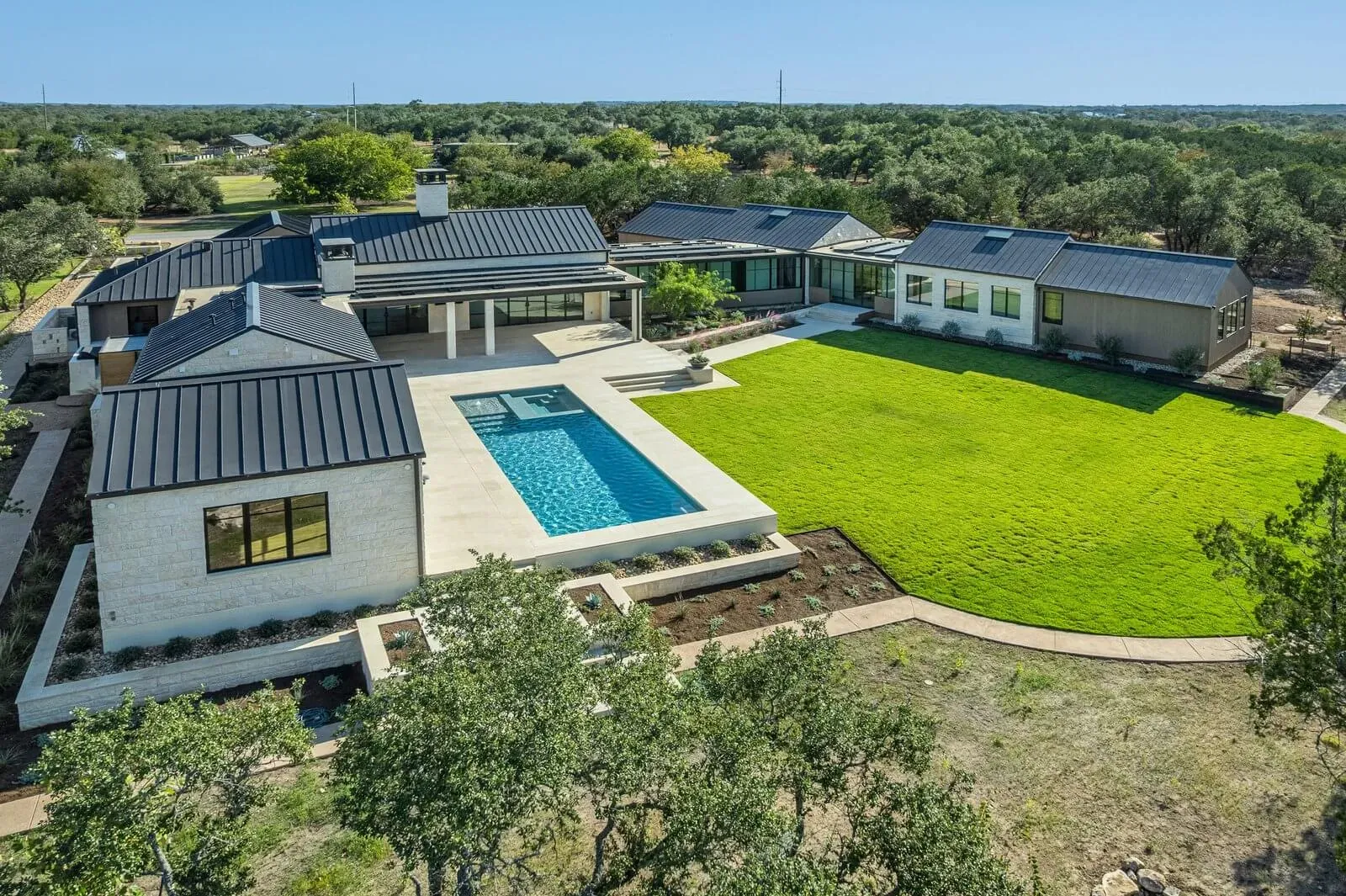
So the site plan is part of the question. Travis CAD weighs the improvements and the use of the land around them, and Hays CAD, absent a survey or homestead claim, what is fenced or marked by roads or landscaping. Where the house, drive and outbuildings go, and how tightly they are grouped, is worth raising with the district before the plan is fixed.
We read the geotechnical report before design starts, and a survey can put the homesite on paper. The septic field and water, including rainwater collection, go on the same plan; our guide to aerobic septic system costs covers the septic side. If horses are part of your plans, equestrian estate design covers how barn, arena and house sit together.
Confirm your parcel with the appraisal district and your CPA.
Frequently Asked Questions
Is an ag exemption really an exemption?
No. TPWD says there is no agricultural or wildlife exemption for open-space land, and Travis CAD calls it a special valuation: the land is appraised on its productive value instead of market value.
Does building a house on land with an ag exemption trigger the rollback tax?
A homestead claim alone does not, under Section 23.55(i). The Comptroller’s manual says the owner avoids rollback only while the home stays a residence and, in effect, must occupy it for three years. Where a rollback applies to only part of a parcel, Section 23.55(d) limits the additional tax to that part.
How far back does the rollback tax go, and is there interest?
Up to the three years before the year of the change of use, counting only years the land was appraised this way. HB 1743 (2019) cut it from five years. Since June 15, 2021, there is no interest on the rollback unless the bill goes delinquent.
When is the agricultural appraisal application due?
Before May 1, so plan for April 30, on Form 50-129 filed with the appraisal district. A late application, ordinarily accepted until the records are approved (usually July), carries a penalty of 10 percent of the tax difference, with exceptions for qualifying new owners.
Can I move newly bought land straight to wildlife valuation?
Only if it already carries an agricultural (or timber) appraisal when the wildlife management use begins. A tract reduced in size since January 1 of the preceding tax year must also meet the district’s minimum acreage.
If I buy land with an agricultural appraisal, do I have to apply again?
Generally yes. Since January 1, 2026, Section 23.54(e-1)(2) treats ownership as unchanged if the land was appraised this way the preceding year, the new owner uses it in materially the same way, and the same individuals oversee or conduct that use. Otherwise, apply by April 30.
If you own acreage in Travis, Hays or Blanco County, or are weighing a tract before you close, and want the homesite and the house planned by the team that will design and build them, call (512) 402-9222 or start a conversation with our team.
Planning a custom home?
Our architects and builders work as one team, from the first conversation to the day you move in.